
Report: Humanitarian response by the UN and humanitarian partners during phase one of the ceasefire

Highlights
- Phase One of the Gaza ceasefire, from 19 January to 1 March 2025, allowed the humanitarian community to rapidly implement a prepared scale-up of its response. It enabled the daily entry of a large volume of humanitarian supplies and a steady stream of fuel. Additionally, it significantly improved the overall security environment and humanitarian access within Gaza.
- Humanitarian partners secured assistance to nearly everyone in Gaza. Humanitarian support included food parcels, tents, multi-purpose cash and psycho-social interventions, among others. Aid workers significantly increased people’s access to essential services like water and health care.
- However, restrictions on the entry of critical humanitarian items continued and access to some areas was still restricted. This limited the progress that could have been achieved in the rehabilitation, restoration or resumption of water networks, solid waste management, health services, and even small-scale agricultural production.
- Given the scale of destruction and devastation alongside cumulative food, water, health, shelter, education and livelihood needs after 15 months of incessant hostilities, repeated forced displacements and humanitarian access challenges, advancements in living conditions made during the ceasefire will quickly be eroded without sustained access and movement, and a sufficient volume of entry of goods and fuel.
- The Israeli-imposed closure of all crossings for the entry of cargo starting 2 March is already increasing needs and disrupting services.
Situation Overview
On 19 January, a ceasefire agreement came into effect in Gaza, through mediation by Egypt, Qatar and the United States. Phase One of the agreement lasted 42 days, concluding at midnight on 1 March.
During that timeframe, a total of 25 Israeli and five Thai hostages, the bodies of eight Israeli hostages, including two children, and 1,777 Palestinians were released. Another 59 Israelis and foreign nationals are estimated to remain captive in Gaza, including hostages who have been declared dead.
Based on information received from the guarantors of the ceasefire, over 25,000* trucks of goods entered Gaza during Phase One. This included goods coordinated by the UN as well as goods donated bilaterally.
Improved humanitarian access
During active hostilities in Gaza, humanitarian organizations notify or coordinate their movements to pass through or reach people in areas under the direct control of Israeli forces. With some exceptions, this was no longer required during the ceasefire, as active hostilities largely stopped and Israeli forces withdrew to a declared “buffer zone” along the borders. This enabled humanitarian partners unimpeded access to most locations in Gaza. Movements in a two-kilometer-wide strip within Gaza, along the Israeli perimeter fence, continued to require coordination with Israeli authorities.
The cessation of major hostilities allowed humanitarian partners to ease security protocols and move more freely, including in previously hard-to-reach areas. Violent, armed looting of humanitarian cargo, which had previously paralyzed the response, almost disappeared; this is attributed to the entry of cargo in large quantities, from multiple land routs simultaneously, and the deployment of Palestinian Police across Gaza.
On 1 February, medical evacuations to Egypt through the Rafah Crossing resumed, after being halted on 7 May 2024.
Resumption of movement to and from North Gaza
On the morning of 27 January, Israeli forces withdrew from parts of the “Netzarim Corridor,” allowing the resumption – after 15 months – of people’s movement from southern to northern Gaza – on foot via Al Rasheed Coastal Road and by vehicle, subject to prior inspection, through Salah ad-Din Road. An international consortium of private security companies was deployed at the Salah ad-Din checkpoint to conduct vehicular inspections.
The UN and partners observed more than 586,000 people crossing from southern to northern Gaza and, between 30 January and 6 February, over 56,000 people moving north to south along Al Rasheed Coastal Road.
With the reopening of the “Netzarim Corridor,” UN and partners’ efforts focused on rapidly scaling up critical humanitarian assistance in the Gaza and North Gaza governorates to meet the needs of hundreds of thousands of returnee households, as well as those remaining all along – particularly in Jabalya, Beit Hanoun and Beit Lahia – in North Gaza that had been largely cut off from assistance for more than three months. The opening also allowed fuel and cooking gas to begin being delivered consistently and at volumes.
Overwhelming humanitarian needs remain
Fifteen months of heightened hostilities resulted in damage to or the destruction of 89 per cent of water and sanitation sector assets, 92 per cent of homes, 62 per cent of roads, 94 per cent of health facilities, and 88 per cent of school buildings. More than 42 million tons of debris were generated. An electricity cut-off imposed by Israeli authorities, damage to electricity infrastructure, coupled with stringent limitations on the import of fuel and gas, further worsened Gaza’s major energy crisis. Sewage, wastewater and solid waste management mechanisms were heavily affected and virtually collapsed as many were also damaged, made inaccessible and lacked essential operating resources. Moreover, up to 82 per cent of croplands, 78 per cent of greenhouses and nearly 68 per cent of agricultural wells were damaged, cattle losses reached 95 per cent, only one per cent of the poultry remains alive, and 72 per cent of the fishing fleet was destroyed. Overall, the heightened hostilities, with their unprecedented intensity and the resulting devastation of infrastructure, productive assets and service delivery, is assessed to have set back development in Gaza as many as 69 years.
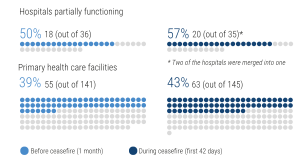
Despite progress made during Phase One of the ceasefire, humanitarian needs across Gaza remain overwhelming: households, particularly in areas of new return, continue to lack access to essential water and sanitation facilities; hundreds of thousands of people are still estimated by the UN and humanitarian partners to be in dire need of tents; critical gaps remain in life-saving health service provision, with 43 per cent of hospitals and 57 per cent of primary health-care centres still not functional as of 1 March; 92 per cent of children aged 6-23 months and pregnant and breastfeeding women are not yet meeting their nutrient requirements; people lack means to restore their livelihoods and resume local food production, with even the short-term food assistance received set to drastically decrease unless the inflow of supplies immediately resume; an estimated one third of all school-aged children continue to lack access to any formal, informal or distance-learning education avenues, and telecommunications and internet services remain severely disrupted.
Humanitarian response during phase one of the ceasefire
The following information was contributed by the respective clusters and sectors. Unless otherwise mentioned, it covers Phase One, from 19 January to 1 March 2025, and excludes supplies and services managed by actors other than the UN and its partners.
Water, Sanitation and Hygiene
Response
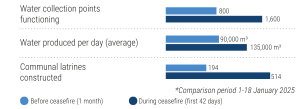
- Water production increased by nearly 50 per cent, from a daily average of approximately 90,000 cubic metres in the month prior to the ceasefire to over 135,000 cubic metres in the last weeks of February. Groundwater wells more than doubled production in six weeks due to steady fuel supplies and basic emergency repairs.
- Sustained efforts were made to initiate the rehabilitation of water and sewage networks. Selective spot repairs were prioritized in locations with higher expected impact in terms of service provision, and where repairs were feasible with the materials available. Repairs of and reinstallation of pumped systems on groundwater wells, municipal desalination plants and sewage pump stations were also started. Achievements include the increased functionality of the South Gaza Desalination Plant after repairs to the F11 electricity feeder line from Israel on 2 February; the rehabilitation of three water desalination plants in Khan Younis, servicing 76,000 people cumulatively; the repair of the Saudi water reservoir and two water wells in Rafah, covering the needs of 100,000 people, and the establishment and expansion of water network sections in North Gaza.
- Water, Sanitation and Hygiene (WASH) Cluster partners also focused on scaling up access to water through trucking, particularly north of Wadi Gaza with the return of displaced people to those areas. As a result, water collection points increased from approximately 800 before the ceasefire to 1,600 by the end of February.
- To further expand access to water supply, the WASH Cluster launched two new fuel allocation mechanisms to facilitate water production by private sector drinking water suppliers and privately owned domestic water wells.
- Solid waste management, which had nearly collapsed, resumed, with over 260,000 tons of solid waste removed across Gaza in the first four weeks of the ceasefire, benefiting about 624,000 people. As of the third week of February, more than 3,340 cubic metres of waste were being collected daily in the Gaza and North Gaza governorates.
- Following the reopening of the “Netzarim Corridor,” the Coastal Municipalities Water Utility (CMWU) was able to transport 700 metres of drainage pipes, which had been blocked in southern Gaza for nearly seven months, to Gaza city, allowing critical works to repair the stormwater system from the Sheikh Radwan water reservoir, to prevent sewage overflows in populated areas. As of 1 March, WASH partners had installed 80 per cent of the pipes and were working on the final section to connect the outflow to the sea.
- During Phase One weeks, over 190,000 hygiene kits and more than 66,500 water jerrycans were distributed to families across the Strip, in addition to approximately 105,000 cleaning kits.
- A total of 524 household latrines and 514 communal latrines were constructed by WASH Cluster partners in areas of return. Since the beginning of February, WASH partners also decommissioned more than 1,700 pit latrines in Deir al Balah and Khan Younis, in sites vacated by displaced people, to reduce public health threats.
Gaps and needs
- Although the volume of water produced and distributed across the Strip substantially increased, as of the end of Phase One, it represented only one third of the overall water supply available prior to October 2023. In areas where IDPs have newly returned, there continues to be an immediate need to truck drinking and domestic water, repair water wells, piped networks and sewage pumps and sewage networks, relocate or construct family latrines and reposition solid waste collection services.
- Phase One of the ceasefire had negligible impact on the entry of certain humanitarian items into Gaza, including critical ones, with nearly no electricity generators, generator consumables and spare parts, or any solar-powered solutions received, very limited entry of pipes, fittings, heavy equipment, water treatment tools, and construction-related materials and the absence of cement. These constraints had a severe impact on the WASH response, significantly hindering repair and service delivery efforts.
- Israeli authorities continued to deny access to the Mekerot Bani Sa’id water line from Israel, preventing the repair of a critical drinking water source that could produce 10,000 cubic metres of water per day. This significantly affected water accessibility for residents in Al Bureij, Al Maghazi, Deir al Balah and Khuza’a municipalities.
- In Rafah, approximately 50 per cent of WASH assets in the declared “buffer zone” remained inaccessible, affecting water production, treatment and distribution, as well as sewage pumps and the wastewater treatment plant. The UAE-built drinking water supply line was not repaired, a further loss of another potential 10,000 cubic metres of water per day.
- While enhanced access enabled an increase in primary waste collection and transfer to temporary dump sites, approximately half of these sites are already full. The continued denial of access to two major landfills – Sofa and Juhor ad Dik – remains a critical impediment. The shortage of vehicles and tools to transfer waste from temporary dump sites to landfills - with 80 per cent of vehicles and containers required to run solid waste collection services either damaged or lost and spare parts unavailable to repair remaining vehicles - also posed additional constraints.
Food security
Response
- The Food Security Sector (FSS) and its partners brought over 78,000 metric tons of food assistance into Gaza, compared with approximately 23,000 tons in the month prior to the ceasefire, allowing an immediate scale-up of food aid distributions (these quantities exclude other sources). While since August, over one million people had not received a full monthly food ration due to supply shortages, in only six weeks, FSS partners were able to reach over two million people with large household-size food parcels. This is in addition to parallel distributions of wheat flour – with UNRWA alone having reached over 1.28 million people with this essential staple – and of over 860,000 hot meals daily across the Strip.
- To make aid more accessible to returnee families in North Gaza, at least five food parcel distribution points were re-established in Jabalya and two in Beit Lahia, with over 200 food distribution points operational across the Strip. The number of kitchens preparing hot meals increased to approximately 180, with eight new kitchens opened in Gaza city, eight in Rafah and the first two set up in North Gaza.
- FSS and partners expanded bread production; due to the steady entry of flour and access to previously hard-to-reach areas, the number of operational UN-subsidized bakeries rose from only five on 18 January to 25 by 1 March. Operating at full regime, these 25 bakeries produced 150,000 bundles of bread daily, with 30 per cent of all bread donated to selected shelters and community kitchens for onward distribution alongside cooked meals, and the remaining 70 per cent sold at modicum prices at the bakeries, and – to further increase bread coverage – at 24 additional selling points in Rafah, Khan Younis and Deir al Balah.
- FSS partners also supported the resumption of local agriculture and livelihoods. To sustain surviving livestock, about 3,000 families in Deir al Balah, Khan Younis and Gaza city and one poultry farm in Khan Younis received more than 1,000 metric tons of animal feed. To support the resumption of household and community-level agricultural production, more than 7,000 vegetable seed kits were distributed in Rafah, Khan Younis and Deir al Balah.

Gaps and needs
- After months of severe food shortages compounded by recent mass population movements, there is a critical need to ensure the steady flow of food assistance into Gaza.
- More than 50,000 metric tons of food supplies are required monthly to assist the whole population of 2.1 million people with full rations and sustain the little progress made towards improved food access during the ceasefire period. This is in addition to supplies required to sustain hot meal production, and the over 9,700 metric tons of flour needed per month to keep subsidized bakeries running without interruptions to ensure that people have access to affordable bread. Unless the inflow of aid immediately resumes, partners will be forced to progressively scale down vital assistance.
- On 8 March, six of the 25 UN-subsidized bakeries - five in Khan Younis and one in Deir al Balah, which had opened after the ceasefire took effect - were already forced to close due to a shortage in cooking gas.
- While some flour and food parcel distributions from previous dispatches have continued, available flour is being prioritized for use at the remaining 19 functional bakeries to sustain their operation, and food rations in stock in main warehouses are only enough for an estimated 500,000 people for one month. As prior to the ceasefire, partners are again being forced to reduce rations to stretch the supplies and reach more people, prioritizing the most vulnerable households. Fresh produce distribution has also nearly completely ceased. Moreover, at least 80 community kitchens are expected to close in two or three weeks due to the lack of supplies, while others will be forced to adjust the meal content or reduce the number of meals prepared to cope.
- With the exception of some seeds and animal feed, the entry of emergency agricultural and livelihood inputs remained restricted. As such, resumption of agricultural activities, including vegetable and fruit production, even at small scale, was highly limited. Fishery inputs and tools also remained restricted.
- While more than 1,000 metric tons of feed concentrate entered and was distributed, only a scant amount is left in stock which will affect meat and dairy production, which are essential particularly for children.
Health
Response
- Health Cluster partners assessed more than 100 non-functional health service points to gauge conditions and identify those that could be restored in the shortest term and with the supplies available. Overall, 17 primary healthcare centres (PHCs) were rehabilitated, while 11 medical points and seven mobile clinics were newly established.
- Critical health services were expanded: in the North Gaza governorate, the outpatient department of the Kamal Adwan Hospital resumed functionality, and the Al Awda Hospital commenced the provision of pediatric services. The Palestine Red Crescent Society (PRCS) transferred a 70-bed field hospital to Gaza city from the south, while both outpatient and in-patient care capacity were expanded at the Wafaa Rehabilitation Hospital. At the Al Shifa Hospital, the Triage and Emergency Department capacity was expanded, while efforts continue to renovate the maternity building. In central and southern Gaza, the triage system at Deir al Balah’s Al Aqsa Hospital was enhanced, and a prosthetics and orthotics clinic was opened in Khan Younis.
- Twenty-five health facilities, including 11 hospitals, two field hospitals and one PHC, received life-saving medications and supplies. These are estimated to meet the needs of approximately 1.9 million people through treatments and surgeries.
- Health partners also enhanced maternal services through the scaled-up provision of medicines and supplies to the 13 hospitals and three field hospitals providing Emergency Obstetric and Neonatal Care. Critical equipment such as fetal monitors, continuous positive airway pressure (CPAP) machines and post-partum kits were also delivered to health facilities, and a maternal field hospital was relocated to the Basa neighborhood of Deir al Balah to address increased needs following population movements.
- To support the local health workforce, the Health Cluster mobilized four new Emergency Medical Teams (EMT). Two international EMTs were deployed to the Indonesian Hospital, in North Gaza, to support the provision of basic outpatient services, and to Al Ahli Hospital in Gaza city, while two national EMTs were deployed to the Al Shifa Hospital, and to the Al Aqsa, European, and Nasser hospitals in Deir al Balah and Khan Younis to enhance surgical capacity at the three facilities. As of 23 February, 26 international EMTs and two national EMTs were operational across the Gaza Strip.
- Between 1 February and 1 March, WHO supported the medical evacuation of 1,108 critically sick and injured patients, including 431 children, from Gaza to Egypt through the Rafah Crossing, alongside 1,676 companions. Fourteen children evacuated to Egypt in February were further transferred to Italy, while another 10 were transferred to Greece under the EU Civil Protection Mechanism.
- A third round of the polio vaccination campaign was completed between 22 and 26 February, reaching 602,795 children under the age of 10 – the entire target population. The ceasefire allowed the health workers to reach more children than during previous vaccination rounds in 2024, including children who may have been missed due to population movements. This most recent round of vaccinations followed the detection of circulating poliovirus in wastewater that confirmed ongoing poliovirus transmission in Gaza.
- To enhance data reporting on communicable diseases, 12 health facilities – five in the north and seven in the south – were supported in setting up WHO’s Early Warning, Alert and Response System (EWARS).
- To strengthen Infection Prevention and Control, a task force was set up at the Nasser Medical Complex and the European and Al Aqsa hospitals in Deir al Balah and Khan Younis.
Gaps and needs
- As of 1 March, 15 out of 35 hospitals, 82 out of 145 PHCs, and 194 out of 360 medical points remained non-functional across the Strip.
- Throughout the ceasefire period, the Israeli authorities continued to deny the entry into Gaza of a wide range of critical medical items, hampering the ability of partners to scale up interventions and ensure the restoration and continuity of services. These include generators and related oil and spare parts to sustain electricity at health facilities; spare parts for ambulances; medical oxygen plants, oxygen equipment and supplies; defibrillators, ventilators, ECG machines and patient monitors; radiology equipment like X-rays, MRIs and CT-scans; laboratory reagents and tools; external and internal fixators for the treatment of fractures; cardiac catheterization equipment; oncology medicines and supplies; vaccines for routine immunization; analgesics; chlorine tabs and liquids, as well as ICT equipment to expand the EWARS and Health information management systems.
Nutrition
Response
- Nutrition Cluster partners increased distribution of blanket nutrition supplements and complementary food as a preventative measure; the screening of children and pregnant and breastfeeding women (PBW); and the treatment of those detected with malnutrition.
- Nutrition partners opened 15 new sites providing out-patient treatment of acute malnutrition across Gaza, and 29 new sites proving blanket nutrient supplementation; as of 1 March, there were 135 and 180 such centres, respectively, across Gaza. The number of sites providing infant and young child feeding services doubled from 160 to over 320.
- Out of 109,600 children under the age of five screened for malnutrition during Phase One of the ceasefire, 3,165 were identified as moderately or severely acutely malnourished and enrolled for treatment. Out of nearly 21,000 PBW who were screened, almost 1,000 were diagnosed with acute malnutrition.
- To strengthen prevention, about 230,000 children and 90,000 PBW received specialized nutrient supplements. Additionally, more than 19,000 infants and young children were provided with ready-to-use complementary food.

Gaps and needs
- Data collected in February showed a slight improvement (from four to eight per cent) in the number of children and PBW consuming the minimum-required food groups. This finding is attributed to the increased availability of goods in local markets. However, 92 per cent of children aged 6-23 months and new or expectant mothers are still not meeting their nutrient requirements.
- More than 25,000 cartons of ready-to-use therapeutic food (RUTF) for the treatment of acutely malnourished children were prepositioned across Gaza. Still, the blanket supplementary feeding programme targeting all children under the age of five and all PBW in Gaza requires the sustained, at-volume entry of both nutrient supplements and ready-to-use complementary food. Due to the massive destruction of infrastructure in the Gaza Strip, nutrition partners have limited storage capacity, increasing reliance on new inflows for even short-term activities.
Shelter
Response
- The Shelter Cluster and its partners distributed or registered the distribution of 111,758 tents – more than 96,946 in the north and about 14,812 in the south; these include bilateral assistance that the cluster is aware of. By contrast, in the month prior to the ceasefire, only 2,591 tents were distributed. Also during Phase One, tarpaulins were distributed to 346,000 people, sealing-off kits to 29,363 people and other non-food assistance, including bedding kits, blankets, mattresses, kitchen sets and clothes to 872,308 people. These figures relate only to shelter materials provided or facilitated through UN coordination.
